Designing upgrade journeys
UX & Service Design | Piclo | B2B SaaS | 5 min read

Help
Project summary
-
Company: Piclo (B2B SaaS)
-
My Role: UX & Service Design Lead
-
Project Goal: Lead the UX and service design for new in-platform plan upgrades and the redesign of user roles and permissions to enable Piclo to transition to a tiered pricing model and unlock additional revenue (scope focused solely on energy buyer journeys).
-
My activities: Desk research, stakeholder workshops, journey mapping, service blueprinting, UI wireframing and prototyping, roles and permissions design, quality assurance testing.
-
Timeline: 3 Agile Sprints
-
Impact: All existing customers successfully transitioned, and the upgrade sales campaign launched on time, securing new buyer organisations within the first two weeks.
The Problem: Unlocking Revenue through a Strategic Pricing Pivot
Piclo's existing marketplace relied on a slow buyer-led model where grid operators' (Buyers) bespoke contracts, negotiated every few years, meant we lacked a consistent, steady revenue stream from Buyers and had no revenue from energy generators (Sellers).
The leadership sought to validate a new strategy: introducing a three-tiered subscription-based pricing model to accelerate revenue and encourage Seller engagement.
-
Strategic Challenge: The new model required Sellers to be encouraged toward paid features (in the future) and enabled Buyers to access the platform at low or no cost, avoiding lengthy procurement tenders. My design scope was strictly focused on the Buyer's upgrade experience in order to take a lean approach to validating the strategy.
-
Core Design Challenge: I had to design the in-platform upgrade journeys for Buyers and redesign the entire user roles and permissions structure to align with the new tiered system.
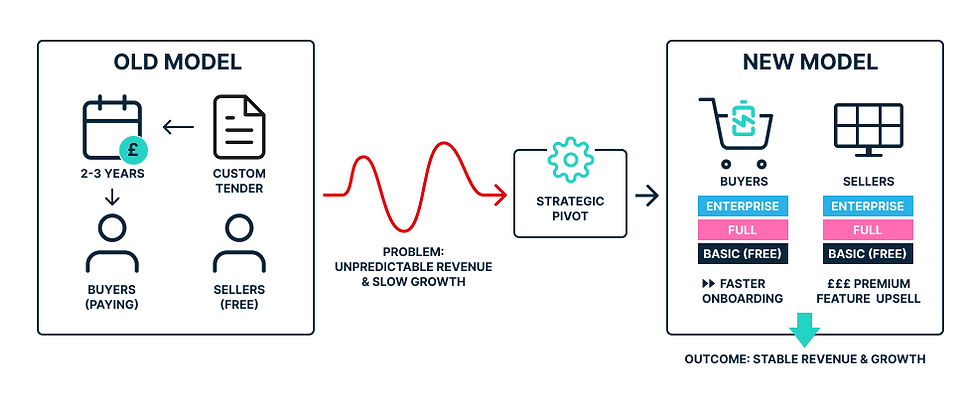
The high-level business goal: replacing slow, cyclical revenue generation with a scalable, tiered approach to ensure faster Buyer onboarding and stable, accelerated revenue growth.
My Research & Design Approach
My approach focused on rapid iteration, strategic collaboration, and meticulous ownership to handle the complex technical and commercial dependencies within the 3-sprint timeline.
-
Collaboration & Alignment: I collaborated closely with Commercial, Marketing, and Production teams throughout each sprint to define the feature sets and value propositions for the Buyer tiers, ensuring total alignment. I was responsible for leading and facilitating all key design meetings and workshops within the product team.
-
Foundational Mapping: I mapped the user journeys for Buyers and Sellers (for context) and designed Service Blueprints for the "As-Is" and "To-Be" scenarios to understand the required migration steps and help co-design new sales and customer support processes and workflows.
-
Managing Competing Priorities: This project required significant focus (50% of my time), demanding sharp prioritisation to balance the tight 3-sprint deadline with the ongoing duties of my usual lead designer role across other projects.
-
Access Control Discovery: I used an AI-first approach to evaluate complex access control models like RBAC, ReBAC, and ABAC. I found that roles based on one model type could not cover every organisational scenario I needed to design for, leading to the strategic decision to adopt a hybrid roles and permissions model.
-
AI-First UI design: I took an AI-first approach using tools (including Gemini and Figma Make) to quickly explore and iterate different UI designs, incorporating best practices for upgrade journey design and gathering rapid internal feedback.
-
Governance and Delivery Ownership: I took full ownership of the quality assurance (QA) for the new UI, creating specifications for engineers during handoff, to the level of detail they asked for, and performing rigorous QA testing to ensure the design, logic, and access controls were implemented correctly and worked as intended across all tiers.

Service Blueprint comparing As-Is and To-Be journeys to align stakeholders on migration steps and new cross-functional support workflows.

Leveraging Gemini to evaluate complex access control models and architect the final hybrid permissions system.
Solution & Design Details
The solution was a two-part system that simplified front-end communication and backstage governance, specifically tailored for the Buyer experience.
1. Simplifying Roles and Governance
To deal with the hybrid nature of access (Org Plan + Team Membership + User Role), I secured approval for a new access logic after successful stress-testing in stakeholder workshops. I simultaneously simplified the backstage system by:
-
Creating a small number of new roles based on key areas of product functionality, which mapped easily to Buyers' existing mental models.
-
Creating a dedicated Account role focused solely on managing other users' roles/teams and changing the organisation's tier.

Stress-Testing System Logic: A comprehensive audit of the permissions architecture to identify friction points in the user journey and ensure a secure, scalable foundation for the new roles and permissions model.

Account role - Full access to billing and team management.
Permissions checking process and plan functionality.
Simplified Roles: A systemic overview of 8 distinct user roles mapped across the platform's Information Architecture.
2. Frontstage Upgrade Journeys
I designed the UI to guide Buyer users positively toward sales engagement rather than denying access.
-
Positive Cues: Instead of padlock symbols, the UI used arrow icons in the navigation menu and positive copy to signify restrictions, encouraging users to explore upgrade options.
-
Sales Enablement: The UI clearly displayed plan information and included calls to action to increase access. The in-platform chat assistant was updated to enable users to easily submit requests for conversation with the sales team.
-
Visionary Design: I used Figma Make to produce future-looking designs to provide inspiration for future iterations of the platform, demonstrating a strategic vision beyond the immediate launch.
Help
Final Upgrade UI: Guiding users toward upgrades through clear navigation cues, plan transparency, and direct sales touchpoints.

Visionary Concept: Exploring AI-driven automation to simplify the backstage complexity of organisation and plan management.
Impact and Strategic Results
My work ensured the foundational design, process logic, and implementation were stable, allowing the business to execute its strategic pivot flawlessly.
-
Successful Strategic Launch: The designs were implemented successfully and on time, ensuring alignment and consistency with Piclo's public-facing information.
-
Executive Communication: I proactively shared progress and direction of travel at weekly company-wide 'show and tell' meetings. This communication was vital for securing cross-functional buy-in and maintaining organisational awareness of the significant pricing pivot.
-
Metrics: All existing Buyers were successfully migrated to the new tier structure.
-
Sales Enablement: The sales campaign launched on time, and within the first two weeks, several new Buyer organisations signed up for trial accounts, validating the commercial appeal of the new low-entry-cost plans.
-
Operational Success: The successful implementation of the new, simplified hybrid roles and permissions structure laid the foundational data model for Piclo's future tiered pricing and revenue growth strategy.
This case study demonstrates my ability to lead and execute both UX design and end-to-end service design on business-critical product and service changes. Head back to the homepage to see more projects.
Other projects you can ask me about
-
Service Design: Evaluating customer and employee interactions with a supermarket's self-service checkouts at a major retailer
-
UX design: Prototyping and testing of a website selling electric vehicles, chargers and tariffs
-
UX research: An 8-week diary study assessing the impact of the COVID-19 lockdown on banking experiences
-
UX research: Field-based usability testing of a digital visitors guide for a Tudor palace
-
Product design: International human factors research and design of a luxury coach